Saturday, May 24, 2014

Perspectives on diversity and culture...A survey

This week, our assignment was to ask 3 people to define what they thought culture and diversity are.

"What is culture?"
My husband: The traditions, customs that are passed down over time that define a group of people.
My sister:  A group of people who are, because of geography or religion, similar in belief and social understanding.
My daughter (5.5 years old): It means you speak a language, like Chinese, and have special clothes and traditions, like Chinese New Year.

"What is diversity?"
My husband: Something that is not homogenous.
My sister: A group of items or people that are different.
My daughter: It's like Helen Keller.  She was blind and deaf and she learned sign language. People are different and special.  

It is always interesting when you ask people what culture is, and what diversity is.  Often they have stop and think about it, and they may not even think they know the answer.  I chose these three people because they represent interesting differences.  My husband, is also American, but grew up in a very different family culture than mine.  My sister grew up with me, but I was curious what she would say, because her life experience has not been mine.  My daughter has been learning about culture and diversity at school, so I thought her answer would be interesting.

I think that I got some relevant, accurate descriptions of culture, although diversity was a bit harder for them to define in detail.  What I learned from the answers I received is that even though we do not think about it, culture and diversity are concepts that we clearly understand, even from a young age.

My daughter Sydney at a Hula performance

Thursday, May 15, 2014

Beginning of EDUC 6164: Perspectives on Equity and Diversity

My Family Culture

This week we were given a scenario to answer:  A major catastrophe has struck our country and the emergency government has decided to evacuate us to other countries willing to take refugees, but we have no choice in where we will go.  The culture will be completely different from ours and we may have to stay permanently.  Evacuees may take one change of clothes and 3 small items.  The items I take are those that I hold dear and represent my family culture.

The three items I would take are my iPad, my favorite book and a piece of jewelry from my mother.
I would take my iPad (assuming it was useable) in order to have my family pictures, access to my genealogy and family tree, as well as access to information about  the culture and country I am going to.  I would take my favorite book as a link to my culture and to have entertainment I am familiar with.  I would take a piece of jewelry from my mother in order to have something to pass on to my children and give them a connection to their family and culture.  If I had to give up all but one item, I would keep the jewelry.  I honestly could live without any of these things, but the jewelry holds the most sentimental value to me.

As I was thinking about this scenario, I thought of my relatives who left their home cultures and families to move to this country, leaving everything they knew behind.  They had to learn a new language and assimilate to a new culture, but they also carried with them the knowledge and customs of their home countries and passed it down to their children.  I would hope that I could do this if I had to face the same situation.


Sunday, April 20, 2014

When I think of research... (End of course reflection)

I used to think that research meant long hours in the library pouring over books and articles to find the information I needed to write a paper.  After taking this course, I now know that research has many different meanings and contexts.  I have also learned that there are many ways to do research and specific methods to utilize.  Conducting research in the early childhood field is not something that I had ever considered to be relevant to my work, but I can see that it can be very relevant.  If there is ever an issue I need to clarify or look into, knowing how to conduct research on it will be a huge help in getting the right information.

The challenges I found in this course were learning all the new terms for the different research methods and keeping them straight.  The only way I learned them was by reading and re-reading until I had them right :)

As an early childhood professional, this course has helped me by teaching me how to read research without spending hours and how to conduct research in a way that is valid, feasible and ethical.  Both of these skills will benefit me professionally by allowing me to read research in the field and understand how it was done.

Overall, this course would not have been one that I would have chosen to take, but like all the previous courses in this program had much to teach me.  I am glad I got to take it.

Thank you to all my colleagues in this course.  Your professionalism, skill and support have been invaluable to me.

Wednesday, April 2, 2014

Research Around The World

For this week's blog assignment we have the option of exploring three different early childhood websites.   The choices were:
http://www.ecdvu.org/ssa/index.php - Early Childhood Development Virtual University-Sub Saharan Africa

http://www.earlychildhoodaustralia.org.au - Early Childhood Australia

http://www.eecera.org European Early Childhood Research Association

I chose Early Childhood Australia because I already have some experience with this organization.  This organization was one of two out of six early childhood organizations that I contact and that responded to my request for a contact, an assignment we had in our last course.  The person who ended up being my contact from Early Childhood Australia was very informative and so happy to collaborate with me.  

On the site there is a link to Research in Practice Series (RIPS).  These are publications that "provide practical, easy-to-read resources for those involved in the early childhood field".  I perused the list and they topic cover professional development, challenging behavior, play, transitions, diversity, and so many others.  ECA Webwatch is a free newsletter that you can subscribe to.  This e-newsletter offers an eclectic mix of information on early childhood development, growth and learning, early childhood practice, programs and policy, emerging issues and research.

Friday, March 21, 2014

My Ultimate Research Dream

If I could conduct research on any topic in child development that would have long lasting benefits to society, I would conduct research on common core standards and its effect on the early childhood field.  I personally have concerns regarding common core and its top down approach to education.   The fact that it was produced by the National Governor's Association does little for me in the way of convincing me of the educational value of the standards.  According to the National Association for the Education of Young Children (2012), the focus on only two standards, and the absence of social-emotional development and approaches to learning is of great concern.  I would like to research how this is going to affect children's outcomes and if it is actually going to be beneficial.

References:
National Association for the Education of Young Children. (2012).  The common core standards: Caution and opportunity for early childhood education.  Retrieved from http://www.naeyc.org/files/naeyc/11_CommonCore1_2A_rv2.pdf

Saturday, March 15, 2014

New Course: EDUC 6163: My Research Journey

This course is entitled Building Research Competencies.  This week I am to post the topic that I am interested in that will serve as my research topic simulation.  I chose challenging behavior in young children, with subtopics of factors that contribute to the behavior, the difference between misbehavior and developmentally appropriate behavior and how to deal with both, and the role of parenting in challenging behavior.  I chose this topic because it is an issue that I deal with on a daily basis as a child development center director working with children in the classrooms.  I have found myself sometimes without a clue as to how to help a child who consistently displays inappropriate behavior, and nothing I or my colleagues do seems to help the behavior.  I would like to gather more information about why these behaviors occur and what can be done for to correct some of the more common ones.

Friday, February 28, 2014

End of course reflection

     During this course we have had the opportunity to learn about the state of early childhood in other countries.  For my part, I corresponded with colleagues in England and Australia.  Learning about the issues and trends they face had several consequences in relationship to my professional and personal development.  The first is that I was able to see that early childhood educators throughout the world face challenges that are not uncommon to us in the U.S., while some face concerns we would never have.
     The second consequence of my interactions with international colleagues is that I learned how much they have to impart to us.  The early childhood field is still growing in many countries, and established in others.  Many nations with established systems can be models for us, both in positive and negative ways.
     The third consequence that came from my interactions was the realization that there are many societies that feel early childhood education is important for young children and many people who care deeply about children, equity, excellence and all the other issues that the field faces.
     One goal I would love to see this country strive for is to really look at how other nations have successfully (or not) implemented early childhood education systems, and how we compare to them.  Are we going down the road toward success or failure?  What could we do better?  What are we doing that is right?  I believe that we have the potential to build a system that serves our young children better than any country in the world, but we have to have unity of purpose and strength of will to get the job done.


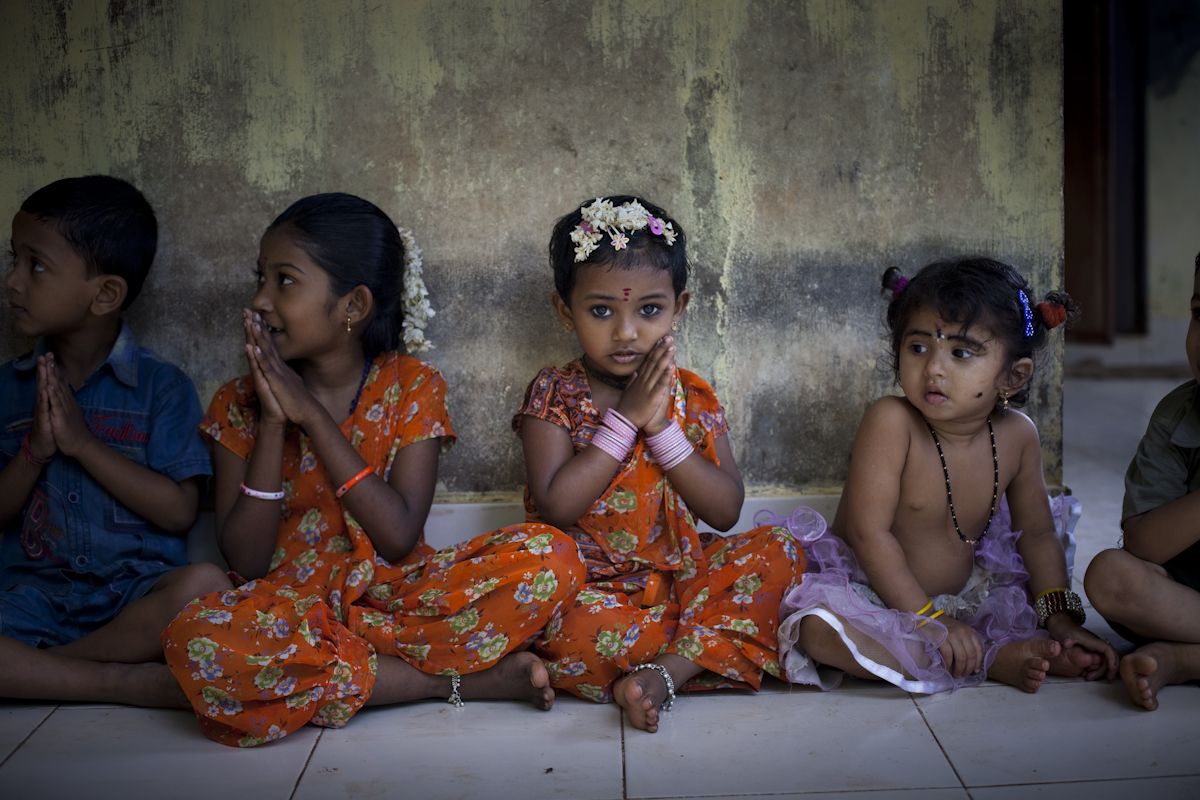
Children at a preschool in Kerala, India.

Preschool Children in China

Preschool Children In A Day Care Centre In Akropong-Akwapim, Ghana

Children at a British preschool in Park Gate, Hampshire, U.K. 


Thank you to everyone who contributed comments to my posts.  I enjoyed reading all of them and I hope to see you in the next class!  Good luck to all of you.