I used to think that research meant long hours in the library pouring over books and articles to find the information I needed to write a paper. After taking this course, I now know that research has many different meanings and contexts. I have also learned that there are many ways to do research and specific methods to utilize. Conducting research in the early childhood field is not something that I had ever considered to be relevant to my work, but I can see that it can be very relevant. If there is ever an issue I need to clarify or look into, knowing how to conduct research on it will be a huge help in getting the right information.
The challenges I found in this course were learning all the new terms for the different research methods and keeping them straight. The only way I learned them was by reading and re-reading until I had them right :)
As an early childhood professional, this course has helped me by teaching me how to read research without spending hours and how to conduct research in a way that is valid, feasible and ethical. Both of these skills will benefit me professionally by allowing me to read research in the field and understand how it was done.
Overall, this course would not have been one that I would have chosen to take, but like all the previous courses in this program had much to teach me. I am glad I got to take it.
Thank you to all my colleagues in this course. Your professionalism, skill and support have been invaluable to me.
Sunday, April 20, 2014

Wednesday, April 2, 2014
Research Around The World
For this week's blog assignment we have the option of exploring three different early childhood websites. The choices were:
http://www.ecdvu.org/ssa/index.php - Early Childhood Development Virtual University-Sub Saharan Africa
http://www.earlychildhoodaustralia.org.au - Early Childhood Australia
http://www.eecera.org European Early Childhood Research Association
I chose Early Childhood Australia because I already have some experience with this organization. This organization was one of two out of six early childhood organizations that I contact and that responded to my request for a contact, an assignment we had in our last course. The person who ended up being my contact from Early Childhood Australia was very informative and so happy to collaborate with me.
On the site there is a link to Research in Practice Series (RIPS). These are publications that "provide practical, easy-to-read resources for those involved in the early childhood field". I perused the list and they topic cover professional development, challenging behavior, play, transitions, diversity, and so many others. ECA Webwatch is a free newsletter that you can subscribe to. This e-newsletter offers an eclectic mix of information on early childhood development, growth and learning, early childhood practice, programs and policy, emerging issues and research.
http://www.ecdvu.org/ssa/index.php - Early Childhood Development Virtual University-Sub Saharan Africa
http://www.earlychildhoodaustralia.org.au - Early Childhood Australia
http://www.eecera.org European Early Childhood Research Association
I chose Early Childhood Australia because I already have some experience with this organization. This organization was one of two out of six early childhood organizations that I contact and that responded to my request for a contact, an assignment we had in our last course. The person who ended up being my contact from Early Childhood Australia was very informative and so happy to collaborate with me.
On the site there is a link to Research in Practice Series (RIPS). These are publications that "provide practical, easy-to-read resources for those involved in the early childhood field". I perused the list and they topic cover professional development, challenging behavior, play, transitions, diversity, and so many others. ECA Webwatch is a free newsletter that you can subscribe to. This e-newsletter offers an eclectic mix of information on early childhood development, growth and learning, early childhood practice, programs and policy, emerging issues and research.
Friday, March 21, 2014
My Ultimate Research Dream
If I could conduct research on any topic in child development that would have long lasting benefits to society, I would conduct research on common core standards and its effect on the early childhood field. I personally have concerns regarding common core and its top down approach to education. The fact that it was produced by the National Governor's Association does little for me in the way of convincing me of the educational value of the standards. According to the National Association for the Education of Young Children (2012), the focus on only two standards, and the absence of social-emotional development and approaches to learning is of great concern. I would like to research how this is going to affect children's outcomes and if it is actually going to be beneficial.
References:
National Association for the Education of Young Children. (2012). The common core standards: Caution and opportunity for early childhood education. Retrieved from http://www.naeyc.org/files/naeyc/11_CommonCore1_2A_rv2.pdf
References:
National Association for the Education of Young Children. (2012). The common core standards: Caution and opportunity for early childhood education. Retrieved from http://www.naeyc.org/files/naeyc/11_CommonCore1_2A_rv2.pdf
Saturday, March 15, 2014
New Course: EDUC 6163: My Research Journey
This course is entitled Building Research Competencies. This week I am to post the topic that I am interested in that will serve as my research topic simulation. I chose challenging behavior in young children, with subtopics of factors that contribute to the behavior, the difference between misbehavior and developmentally appropriate behavior and how to deal with both, and the role of parenting in challenging behavior. I chose this topic because it is an issue that I deal with on a daily basis as a child development center director working with children in the classrooms. I have found myself sometimes without a clue as to how to help a child who consistently displays inappropriate behavior, and nothing I or my colleagues do seems to help the behavior. I would like to gather more information about why these behaviors occur and what can be done for to correct some of the more common ones.
Friday, February 28, 2014
End of course reflection
During this course we have had the opportunity to learn about the state of early childhood in other countries. For my part, I corresponded with colleagues in England and Australia. Learning about the issues and trends they face had several consequences in relationship to my professional and personal development. The first is that I was able to see that early childhood educators throughout the world face challenges that are not uncommon to us in the U.S., while some face concerns we would never have.
The second consequence of my interactions with international colleagues is that I learned how much they have to impart to us. The early childhood field is still growing in many countries, and established in others. Many nations with established systems can be models for us, both in positive and negative ways.
The third consequence that came from my interactions was the realization that there are many societies that feel early childhood education is important for young children and many people who care deeply about children, equity, excellence and all the other issues that the field faces.
One goal I would love to see this country strive for is to really look at how other nations have successfully (or not) implemented early childhood education systems, and how we compare to them. Are we going down the road toward success or failure? What could we do better? What are we doing that is right? I believe that we have the potential to build a system that serves our young children better than any country in the world, but we have to have unity of purpose and strength of will to get the job done.


Thank you to everyone who contributed comments to my posts. I enjoyed reading all of them and I hope to see you in the next class! Good luck to all of you.
The second consequence of my interactions with international colleagues is that I learned how much they have to impart to us. The early childhood field is still growing in many countries, and established in others. Many nations with established systems can be models for us, both in positive and negative ways.
The third consequence that came from my interactions was the realization that there are many societies that feel early childhood education is important for young children and many people who care deeply about children, equity, excellence and all the other issues that the field faces.
One goal I would love to see this country strive for is to really look at how other nations have successfully (or not) implemented early childhood education systems, and how we compare to them. Are we going down the road toward success or failure? What could we do better? What are we doing that is right? I believe that we have the potential to build a system that serves our young children better than any country in the world, but we have to have unity of purpose and strength of will to get the job done.
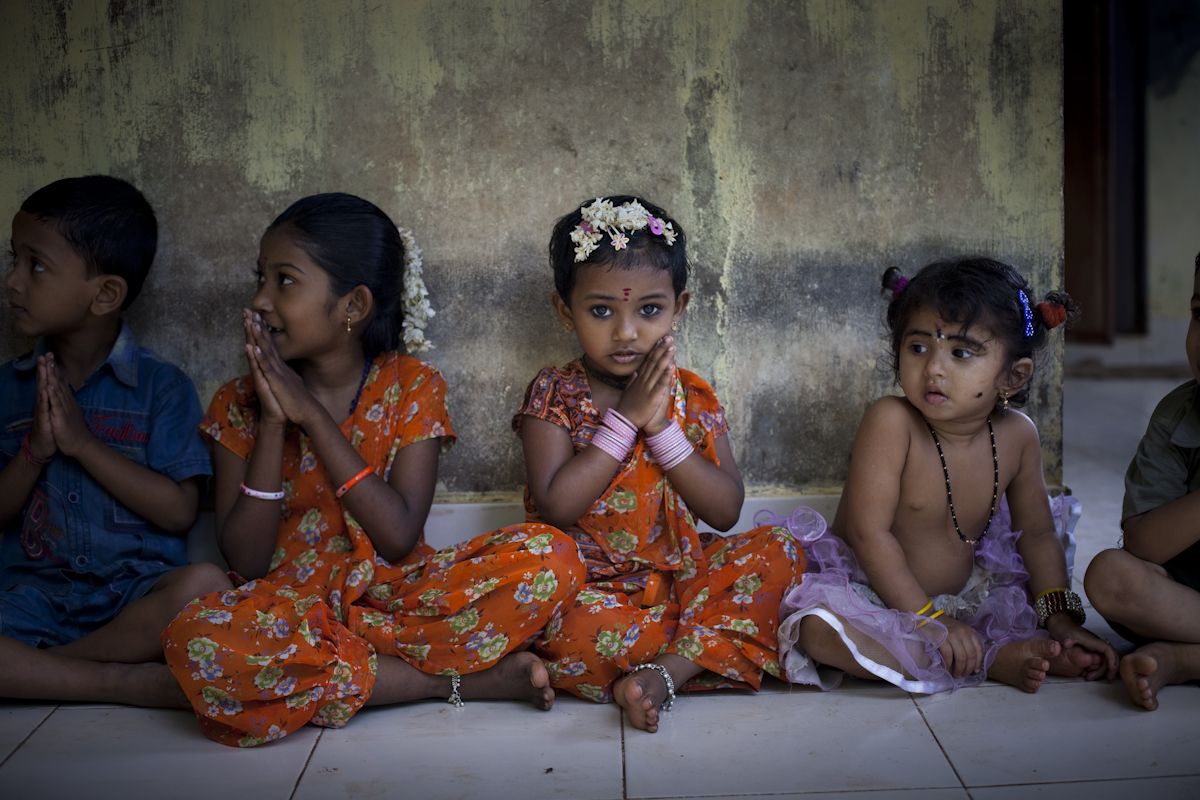
Children at a preschool in Kerala, India.

Preschool Children in China

Preschool Children In A Day Care Centre In Akropong-Akwapim, Ghana

Children at a British preschool in Park Gate, Hampshire, U.K.
Thank you to everyone who contributed comments to my posts. I enjoyed reading all of them and I hope to see you in the next class! Good luck to all of you.
Thursday, February 20, 2014
Final thoughts with my international contact
My contact in Australia related the conditions and requirements for early childhood teachers in Austrailia:
Under Australia's National Quality Framework for Early Childhood Education and Care there are several requirements:
- All educators must be qualified to at least a Certificate III qualification (took effect from 1 January 2014)
- Half of all educators must hold a Diploma qualification(took effect from 1 January 2014)
- A four year Batchelor's degree qualified teacher must be present in the service (took effect from 1 January 2014)
- A second four year Batchelor's degree qualified teacher must be present in the service (takes effect from 1 January 2020)
In addition, the Australian Government has implemented a range of initiatives aimed at supporting, training and retaining an experienced and qualified early childhood workforce and these are complemented by state and territory government training programs and accompanying workforce strategies. Some examples include:
- recognition of prior learning initiatives
- subsidies for educators studying a Certificate III
- removal of fees for educators studying a diploma (NPA on TAFE Fee Waivers)
- subsidies for student loans for early childhood teachers (HECS/HELP Benefit)
The biggest issue for developing excellence in the early childhood sector is wages. There is a significant disparity between the wages of preschool and kindergarten teachers and primary school teachers with the wages and conditions of early childhood teachers in ECEC services. This makes it difficult to attract and retain teachers in the sector.
Although a stable, skilled and professional labour force is widely acknowledged as vital to ensuring high-quality ECEC, educators continue to be poorly paid for the significant work they do in educating and caring for children. While some employers are able to offer above award wages and conditions, as outlined by United Voice (the union representing educators), some qualified educators in Australia earn as little as $19.00 per hour, suffer low status in the broader community, lack fulfilling career paths and have inadequate training opportunities. Addressing educators' low wages would augment the quality reform agenda and is essential to ensuring the future viability of the sector which supports Australian families and children.
It seems that Australia faces the same challenges as we do in the U.S. when it comes to developing a strong, committed early childhood workforce. The differences lie in the education requirements and incentives for education. $19 an hour seems like a pretty good wage to me, but maybe it is low in Australia.
Learning about child care in Australia and England has been enlightening. It is interesting to see the similarities and also the ways in which things could be done better.
Under Australia's National Quality Framework for Early Childhood Education and Care there are several requirements:
- All educators must be qualified to at least a Certificate III qualification (took effect from 1 January 2014)
- Half of all educators must hold a Diploma qualification(took effect from 1 January 2014)
- A four year Batchelor's degree qualified teacher must be present in the service (took effect from 1 January 2014)
- A second four year Batchelor's degree qualified teacher must be present in the service (takes effect from 1 January 2020)
In addition, the Australian Government has implemented a range of initiatives aimed at supporting, training and retaining an experienced and qualified early childhood workforce and these are complemented by state and territory government training programs and accompanying workforce strategies. Some examples include:
- recognition of prior learning initiatives
- subsidies for educators studying a Certificate III
- removal of fees for educators studying a diploma (NPA on TAFE Fee Waivers)
- subsidies for student loans for early childhood teachers (HECS/HELP Benefit)
The biggest issue for developing excellence in the early childhood sector is wages. There is a significant disparity between the wages of preschool and kindergarten teachers and primary school teachers with the wages and conditions of early childhood teachers in ECEC services. This makes it difficult to attract and retain teachers in the sector.
Although a stable, skilled and professional labour force is widely acknowledged as vital to ensuring high-quality ECEC, educators continue to be poorly paid for the significant work they do in educating and caring for children. While some employers are able to offer above award wages and conditions, as outlined by United Voice (the union representing educators), some qualified educators in Australia earn as little as $19.00 per hour, suffer low status in the broader community, lack fulfilling career paths and have inadequate training opportunities. Addressing educators' low wages would augment the quality reform agenda and is essential to ensuring the future viability of the sector which supports Australian families and children.
It seems that Australia faces the same challenges as we do in the U.S. when it comes to developing a strong, committed early childhood workforce. The differences lie in the education requirements and incentives for education. $19 an hour seems like a pretty good wage to me, but maybe it is low in Australia.
Learning about child care in Australia and England has been enlightening. It is interesting to see the similarities and also the ways in which things could be done better.
Friday, February 14, 2014
Sharing Web Resources
This week we focus on our chose website. We are to follow some outside links or share information we learned from the organization's newsletter. I have not received a newsletter yet, but I did find a link to an interesting organization through the website's literacy page. Part of NBCDI's goals are to ensure all black chidden are proficient readers by grade 3. Sadly, only 15% of black children are reading at their expected level by grade 4. To help counteract this, they are working with two organizations: The Campaign for Grade Level Reading (www.gradelevelreading.net) and Raising A Reader (www.raisingareader.org). Raising a reader is an organization devoted to helping children of families ages 0-8 develop, practice and maintain home literacy routines. NBCDI's goal is through "working with Raising A Reader, NBCDI aims to improve literacy levels within African American communities by engaging families and helping them develop an at-home literacy routine with proven results that link to academic and life success." Reading with children is such a simple thing to do, but it has such a huge impact on their development. Helping parents to understand what it is that reading can do for their child's academic success and for their own relationship with their child is so important and I am happy to see that NBCDI has taken on this initiative and are working with two organizations who see the value in reading to and with your child.
I also relaying the information I got from my early childhood contact in England this week (better late than never!). They wrote:
"The biggest issues related to excellence and quality at this moment in time centre around qualifications.
This includes:
http://www.daynurseries.co.uk/news/article.cfm/id/26/Debate-should-early-years-teachers-have-qualifed-teacher-status
http://sheila-nutkins-author.blogspot.co.uk/2013/03/debate-about-ratios-and-qualifications.html
In addition, the regulator Ofsted has come under increasing fire for standardisation issues:
http://www.bbc.co.uk/news/education-24079951
http://www.nurseryworld.co.uk/article/1214950/exclusive-ofsted-responds-big-conversation
And more recently, 'school readiness' has been at the forefront of agendas:
http://www.telegraph.co.uk/education/10307682/Failure-to-acknowledge-the-concept-of-readiness-in-education-this-is-the-tragedy.html
http://edfaclib.wordpress.com/2013/10/07/guest-blog-post-too-much-too-soon-school-starting-age-the-evidence-3/
Finally - issues over improving the quality within the state sector and comparison to both PISA and other measurements:
http://www.daynurseries.co.uk/news/article.cfm/id/1560801/early-years-professional-launches-petition-in-battle-to-gain-qualified-teacher-status
The relative value, and what is required by practitioners, is currently under review and debate - in an attempt to raise standards both professionally and of those work in the sector."
I also relaying the information I got from my early childhood contact in England this week (better late than never!). They wrote:
"The biggest issues related to excellence and quality at this moment in time centre around qualifications.
This includes:
http://www.daynurseries.co.uk/news/article.cfm/id/26/Debate-should-early-years-teachers-have-qualifed-teacher-status
http://sheila-nutkins-author.blogspot.co.uk/2013/03/debate-about-ratios-and-qualifications.html
In addition, the regulator Ofsted has come under increasing fire for standardisation issues:
http://www.bbc.co.uk/news/education-24079951
http://www.nurseryworld.co.uk/article/1214950/exclusive-ofsted-responds-big-conversation
And more recently, 'school readiness' has been at the forefront of agendas:
http://www.telegraph.co.uk/education/10307682/Failure-to-acknowledge-the-concept-of-readiness-in-education-this-is-the-tragedy.html
http://edfaclib.wordpress.com/2013/10/07/guest-blog-post-too-much-too-soon-school-starting-age-the-evidence-3/
Finally - issues over improving the quality within the state sector and comparison to both PISA and other measurements:
http://www.daynurseries.co.uk/news/article.cfm/id/1560801/early-years-professional-launches-petition-in-battle-to-gain-qualified-teacher-status
The relative value, and what is required by practitioners, is currently under review and debate - in an attempt to raise standards both professionally and of those work in the sector."
Subscribe to:
Posts (Atom)